





“Equinox, Part I”
Written by Rick Berman & Brannon Braga & Joe Menosky
Directed by David Livingston
Season 5, Episode 26
Production episode 220
Original air date: May 26, 1999
Stardate: unknown
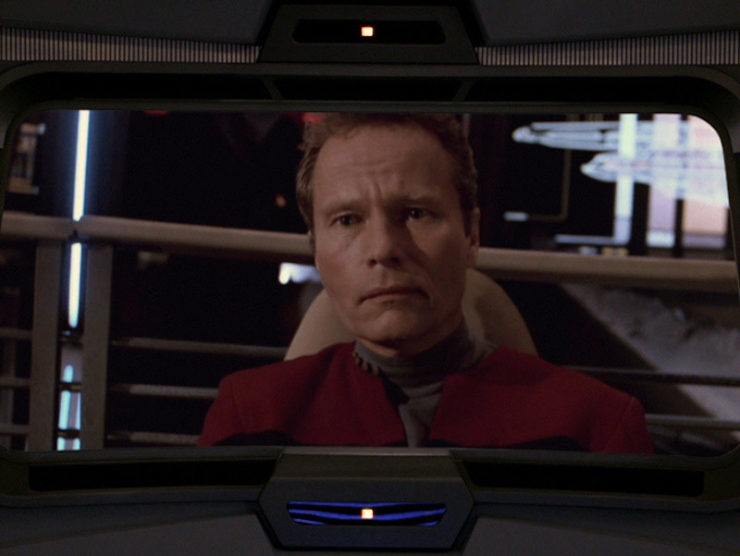
Captain’s log. We open with the U.S.S. Equinox, a Nova-class starship with heavily modified shields, being menaced by creatures that appear in fissures in space. Captain Rudolph Ransom orders their weakened shields to be lowered and reinitialized so they’ll be back at full strength, though that will take forty-five seconds, according to his first officer, Commander Max Burke. They do it, firing phaser rifles at the creatures as they materialize on the bridge, one of which kills one of the crew.
Voyager picks up a distress call from the Equinox. Janeway and Chakotay are gobsmacked to find a Federation starship here in the Delta Quadrant, and wonder if they were sent to the DQ to find Voyager—though that seems unlikely given the class of ship.
Buy the Book
Fugitive Telemetry
They change course and send a rescue party over to the ship after extending their shields around the smaller vessel. Kim and Seven rescue Crewperson Noah Lessing, whose legs have been crushed, while Janeway finds Ransom on the bridge. Ransom asks if Voyager was sent to find them in the DQ, and they both soon realize that they were both kidnapped by the Caretaker.
Within a week of Equinox’s arrival in the DQ, they encountered the Krowtownan Guard, who fired on the vessel for violating their territory. They lost half their crew to the Guard, and took severe damage. They’ve only made it this far due to finding a wormhole—they were also lucky enough to avoid the Borg all together.
Ransom holds a memorial service for the crew they’ve lost to the creatures in the Voyager mess hall. Janeway and Ransom then start the work of coordinating their crews and repairing Equinox. We also discover that Burke is Torres’s ex—they dated while she was at the Academy.
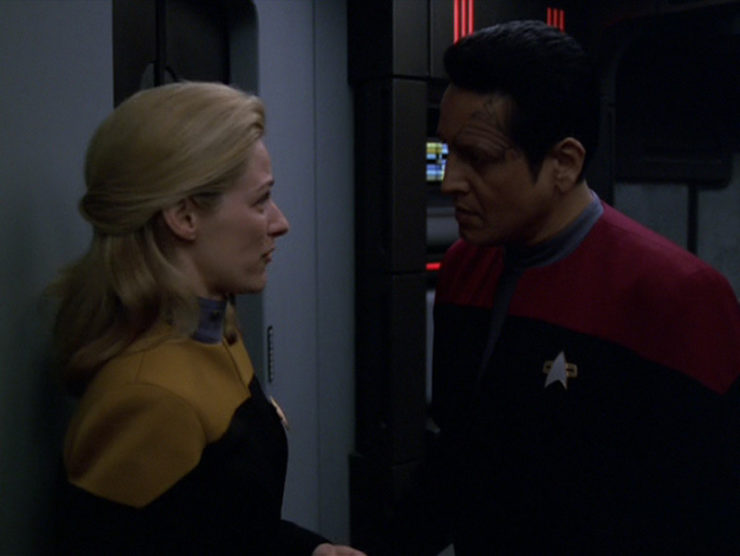
Ensign Marla Gilmore asks Chakotay if they can take Jefferies Tubes to engineering instead of the turbolifts. The Equinox crew has avoided turbolifts, as there’s nowhere to hide if one of the creatures shows up in one of them, and now Gilmore suffers from some serious PTSD and claustrophobia.
The creatures are still attacking the shields, and they’re weakening them by .03% with each attack. The creatures can only survive in our reality for a few seconds. Seven suggests finding a way to hold them, and Burke says they did create a method of holding them in a force field in their lab—but the lab itself is inaccessible, flooded with thermionic radiation. Burke, however, offers to get the schematics for it.
Ransom asks Janeway how many times she’s broken the Prime Directive since being stranded, and Janeway says she’s bent it a few times, but never broken it. (This is an outright lie, given that Voyager violated sovereign territory in “The Swarm.”) Ransom then says it’s been the same for him, which—given the way he phrased the question, assuming that Janeway had broken General Order #1—is probably a lie.
They also find Equinox‘s dedication plaque on the deck and restore it to its place on the bridge.
Ransom goes to Burke in the mess hall, where the latter is enjoying a real meal for the first time in forever. Ransom tells him not to enjoy it too much—if Janeway is any indication, he says, the Voyager crew won’t understand what they’ve done.
The creatures almost penetrate the shields, having changed their tactics to focus their attention on a single part of the shields. It almost works, and they now have less time to figure out a solution.
The only way they can get the force field up and running is in fourteen hours. However, if they only have to cover one ship, it’ll take less time, which is necessary, as the creature will penetrate the shields before those fourteen hours are up. Ransom doesn’t want to abandon his ship, but Janeway insists, and Starfleet regulations are on her side, as in a combat situation with two vessels, command defaults to the captain of the ship with tactical superiority. Ransom, therefore, agrees to follow Janeway’s orders.
Ransom later meets with his crew on the bridge. He orders them to take the field generator once it’s up and running and abandon Voyager. They all agree readily.
Tuvok and Seven discover that the Equinox lab is still flooded with thermionic radiation, which should have dissipated by now. It turns out that several EPS junctions are being directed into the lab—Ransom is flooding it deliberately, probably to keep people out. Janeway orders the EMH to beam over, where he discovers the crystallized remains of one of the creatures, which is emitting a ton of energy. The Equinox crew have been using the force field Burke mentioned to capture and kill the aliens and use them as a power source.
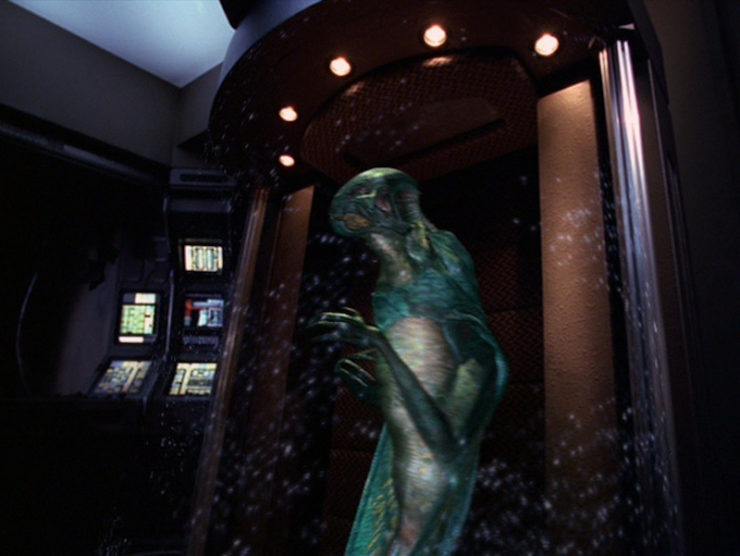
Janeway has Tuvok take Ransom into custody. He admits that they are using the creatures’ corpses to power their warp drive. They encountered a race called the Ankari, who spoke of “spirits of good fortune,” referring to the creatures. Discovering that the creatures had a massive amount of antimatter, Ransom captured one in a force field to study it, but it died—but its corpse proved a massive power source. So they captured a bunch and killed them, enabling them to get 10,000 light-years in two weeks.
Janeway is, to say the least, appalled. Ransom insists he had no choice: their dilithium was gone, they were stuck at thruster power. It was this or be stuck forever. Janeway confines all the Equinox crew to the brig, except for Gilmore, who decrypts the data for the engine modifications. On Equinox, the EMH decrypts the data on the force field, but can’t access it without authorization from the Equinox EMH. He activates it (it’s another Mark 1 like him), and they compare notes. The Equinox EMH (let’s call him EMH-E for clarity) is surprised to see the Voyager EMH able to roam free, and the EMH is surprised to learn that the EMH-E designed the force fields that killed the creatures. The EMH-E reveals that they disabled his ethical subroutines right before he knocks the EMH’s mobile emitter off and takes it for himself. He then beams to Voyager and pretends to be their EMH while freeing Equinox’s crew.
Seven has beamed over to Equinox to dismantle the engine modifications with Gilmore, but Gilmore renders Seven unconscious while Ransom and his crew beam back to their ship. Burke sabotaged the field generator (hiding it from sensors using a trick Torres taught him). Voyager’s shields fail and the creatures start to attack. Ransom orders the field generator beamed to Equinox, and they bugger off, leaving Voyager helpless against the creatures, which all start materializing, including one that goes right for Janeway…
To be continued…
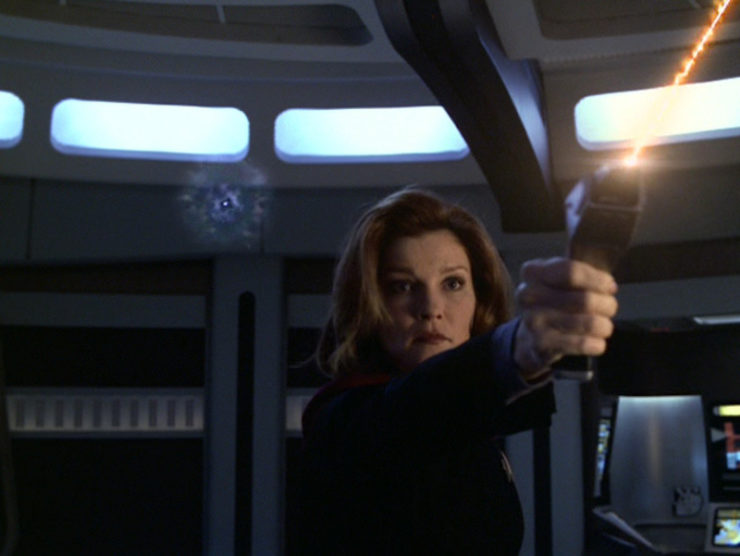
Can’t we just reverse the polarity? The creatures apparently contain antimatter—which may be why they can’t survive in our universe for long—and their corpses can supercharge a warp drive like whoa.
There’s coffee in that nebula! Janeway’s insistence that she hasn’t broken the Prime Directive is a bit unnerving, but whatever Janeway might have done pales in comparison to committing mass murder to get home faster. Her anger at Ransom is palpable.
Mr. Vulcan. At one point, Tuvok admonishes Seven, “There are times when perfection hinders efficiency.” Of course, right after that, her perfectionism discovers that Ransom is deliberately keeping the science lab from Voyager’s prying eyes, so maybe Tuvok could be less snotty. (Probably not, though…)
Half and half. Torres and Burke were a couple at the Academy, and Torres had expected Burke to wash out like she did, but instead he stuck it out, eventually becoming first officer on Equinox. They banter like a former couple…
Please state the nature of the medical emergency. Apparently you can delete the EMH’s ethical subroutines. Who knew?
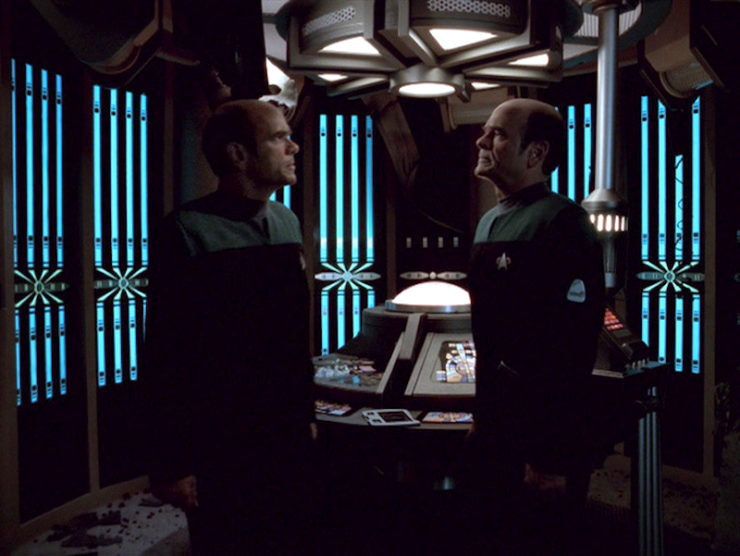
Resistance is futile. Seven says at one point that she welcomes the chance to observe more of humanity in the Equinox crew. Gilmore later apologizes to her for not being a sterling example, but Seven says that she’s learned a lot from studying them. Not enough, though, as that’s just a few minutes before Gilmore renders her unconscious. In the end, she’s stuck on Equinox as they abandon Voyager.
No sex, please, we’re Starfleet. Burke called Torres “BLT,” a reference to both the sandwich and her initials. Paris acts more than a little jealous despite protesting a bit too much that he isn’t, and Kim slaps him on the back and calls him “Turkey Platter.”
What happens on the holodeck stays on the holodeck. Equinox either doesn’t have holodecks or doesn’t have power to them or something, as their substitute is a VR device that they got from the Poneans. Gilmore describes meeting them as one of the few good things that has happened to them since they were stranded.
Do it.
“You and your crew will be confined to quarters.”
“Please, show them leniency—they were only following my orders.”
“Their mistake.”
–Janeway laying down the law, Ransom trying to protect his crew, and Janeway having none of it.
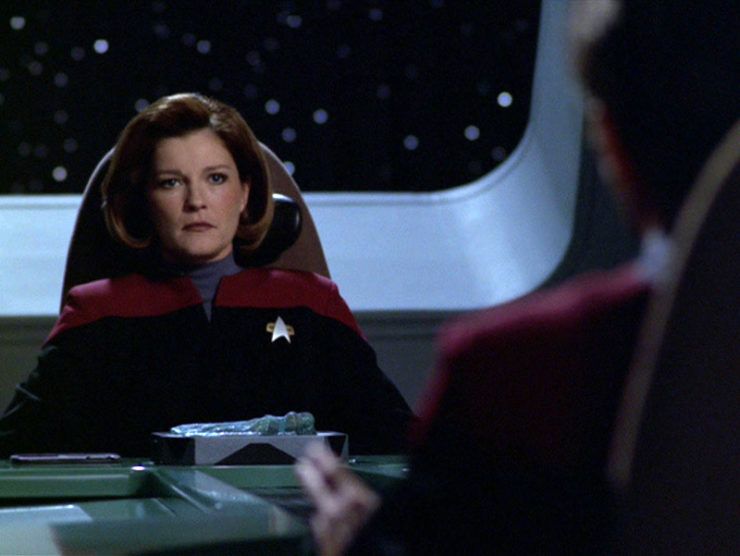
Welcome aboard. Some fantastic guests in this one. The biggie at the time was the great John Savage as Ransom. The biggie now would probably be the superlative Titus Welliver, currently being amazing as the title character in Bosch, as Burke.
We’ve also got Rick Worthy as Lessing; he last appeared as the android in “Prototype,” and also was in DS9’s “Soldiers of the Empire” as Kornan and Insurrection as an Elloran. He’ll also have a recurring role as the Tellarite Jannar in Enterprise’s third season.
Olivia Birkelund plays Gilmore and recurring regular Scarlett Pomers shows up as Naomi.
All of the above save for Pomers will be back in Part II.
Trivial matters: This episode and Part II were novelized by Diane Carey. The novel was released in time for the airing of Part II in the fall of 1999.
Thermionic radiation is the latest bit of fictional radiation Trek has given us, this one first established in “Demon.”
The Krowtownan Guard is unfamiliar to Janeway, which makes you wonder why Equinox encountered them when Voyager didn’t, but it’s also possible that Neelix warned them away from the Guard, an advantage Ransom didn’t have, and Janeway just didn’t recall the name five years later.
Titus Welliver reportedly took the role due to both being a longtime Star Trek fan and being a longtime fan of John Savage and wanting to work with him.
It’s not clear how much truth there was in Ransom’s early discussions with Janeway about their journey given that he was hiding their souped-up warp drive, though it’s perfectly possible that they did also find a wormhole, which, if nothing else, would explain how they’ve avoided the Borg, as that wormhole could’ve leapfrogged Borg territory.
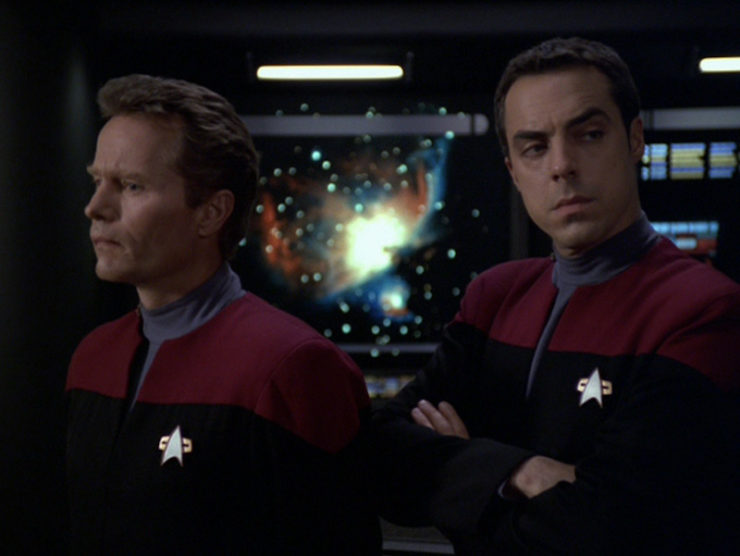
Set a course for home. “We can’t let Voyager stop us now, not when we’re this close.” This is a really good concept, one that, frankly, we should’ve seen more of. Given that it was established way back in “Caretaker” that the titular character was kidnapping ships from all over the galaxy to find a successor, it’s more peculiar that they’ve only encountered one other refugee ship in five years.
And through the Equinox crew, we get to see the show we could have gotten if the executive producer and the network weren’t so utterly afraid of rocking the boat on their flagship show. We’ve been down this road before in places like the “Year of Hell” two-parter, “Deadlock,” and “Course: Oblivion,” where the show actually embraced the notion of being stranded far from home as being a hardship rather than just another day at the office, but did so in a manner that had no real consequences for the crew. That holds true here, too, as it’s the Equinox that suffered all these hardships and made horrible moral decisions.
The problem is, the script doesn’t quite do what it needs to do to be effective. There are no shades of gray here: the Equinox crew are pretty close to irredeemable. They’re engaging in mass murder of sentient beings in order to get home faster.
Now, I will give them credit for showing the desperation of the crew. We’ve seen this before on the show, where our heroes have tried all sorts of crazy-ass shit to get home faster. And Gilmore in particular is obviously suffering some serious PTSD from what they’ve been through.
But what they’re doing to the alien creatures is (a) beyond the pale and (b) counterproductive and stupid. They lost five crewmembers in the attack that Voyager rescued them from, and they’ve only got less than forty people on board at this point. The creatures are very obviously not going to leave them alone, and at this rate of attrition, there’ll be nobody left on board to make it home.
The casting kinda works against them, too. Neither John Savage nor Titus Welliver are known for playing nice people, and the very act of casting them makes you not trust the characters very much. Mind you, they’re both superb—Savage sells Ransom’s desperation and dedication, and Welliver is never anything less than brilliant in anything he does.
I find myself wishing that they hadn’t gone full murderer with them, making it a bit more nuanced. Maybe if they just captured the creatures instead of killing them. As it is, it’s hard to stomach what they’re doing, especially when we see Gilmore going from fragile with Chakotay to casually and calmly rendering Seven unconscious and leaving Voyager to their fate. The depraved indifference the Equinox crew shows to our heroes makes it even harder to sympathize with them in any way. They should be grateful for Voyager’s presence, regardless of how they’ve become morally compromised, and instead they leave them to die.
I will give this episode credit for one thing: it works on its own quite well. Far too many two-parters spend the first part doing all setup, but “Equinox, Part I” is a story with a beginning and a middle and an end that tells its own complete tale—albeit one that ends in a cliffhanger.
In addition, I must sing the praises of the performances. Besides Savage and Welliver, Olivia Birkelund does an excellent job with the emotionally damaged Gilmore, as does Robert Beltran in his interactions with her as Chakotay. Roxann Dawson banters beautifully with Welliver, and Kate Mulgrew’s slow burn as she goes from rescuer to fellow captain to captain who disagrees with Ransom and has to pull rank to get him in line to his captor is a sight to see. It’s in this last mode that that slow burn turns into an inferno, as Janeway is (understandably) pissed. And Robert Picardo is superb as two different versions of the EMH. I especially love the casual way the EMH-E says that his ethical subroutines were deleted right before he knocks the mobile emitter off his counterpart’s arm.
Still, this stacks the deck a little too much to work as well as it should.
Warp factor rating: 6
Keith R.A. DeCandido is also reviewing each new episode of The Falcon and the Winter Soldier as they’re released on this site.


I always loved Equinox! As with the other episodes KRAD mentions, it proves that Voyager really did have what it took to live up to it’s premise and be more interesting and nuanced. Yea, they went a little too far in making the Equinox crew mustache twirling villains, and I wish we had gotten to spend a little more time with them so that we felt their desperation more, but it was still a great contrast. There is an almost-meta quality to this episode, as if the writers were acknowledging that yea, the crew on Voyager has basically been on a pleasure cruise for the past 5 years (the Holodecks work, everyone sleeps in a nice clean bed, no one who matters ever dies, and once we got rid of Suter and Seska everyone gets along, and they meet plenty of friendly aliens willing to help them out), and that getting stuck in the Delta quadrant honestly should have taken a much larger toll on them.
Janeway’s been breaking the Prime Directive from the jump and finding ways to justify it to herself, so I’m never surprised to hear her claim she doesn’t in this episode, but I do wish the show itself had a little more self-awareness about the situation. The line reading and blocking of the scene leads me to believe that the audience is intended to agree with her assessment of her own performance, which is more than a little laughable.
As with the eternal question of Holodeck safeties, it’s not that it’s wildly unreasonable that a skilled programmer with command access could bypass or subvert the ethical subroutines of an Emergency Medical Program, but I can’t shake the idea that it was probably accomplished by announcing, “Computer, deactivate EMH Ethical Subroutines, Command Authorization Ransom Alpha Three Three Tango.”
I love this episode – it’s refreshing to see new Starfleet officers and learn how they weren’t as lucky as Voyager after being pulled into the DQ.
One thing that always bothers me: Janeway says “Drop shields, bridge only” and later orders the same for the cargo bay. Seeing as the shields form a bubble around the ship, dropping shields in one specific place seems odd.
I agree — this is another one where it feels like the writers are saying, “Psst, here’s the show we wanted to do all along but weren’t allowed to, so we’ll sneak it in as an alternate timeline or a duplicate ship or, heck, just a different ship entirely.” It’s a little too dependent on coincidence, both the coincidence of the ships happening to cross within a few light-years on their highly disparate routes home and the coincidence of B’Elanna’s ex being the first officer.
I’m not sure whether Rick Worthy was just underused here, or if, like Michael Dorn, he needed more seasoning to grow into a really fine actor. He was excellent on Enterprise, and he’s fantastic as Dean Fogg on The Magicians. I would love to see Worthy appear on Strange New Worlds as Richard Daystrom — he’d be perfect for it.
“The Krowtownan Guard is unfamiliar to Janeway, which makes you wonder why Equinox encountered them when Voyager didn’t”
Space is big. Just a slight difference in course and you can miss whole civilizations. It’s no stranger than, say, the Pollux system still being unexplored by Starfleet in the 23rd century even though it’s only 34 light-years away. There are a lot of stars in even a single sector of the galaxy, and it takes time to get to them all.
It could be that, instead of specifically warning them away, Neelix said “Let’s go over here because there’s a great foraging/trading planet” and they therefore skirted Krowtonan territory by pure chance.
“Given that it was established way back in “Caretaker” that the titular character was kidnapping ships from all over the galaxy to find a successor, it’s more peculiar that they’ve only encountered one other refugee ship in five years.”
As I’ve mentioned before (and touched on in Places of Exile), I felt Janeway should’ve actively searched out the other refugee ships and put together a whole caravan, rather than foolishly setting out alone and negligently ignoring the plight of the others.
@@.-@ Would that caravan have featured a casino ship, prison ship, assorted merchant and civilian ships, and the last Battlestar, while they all search for a way to a mythical planet called Earth?
KRAD- It never bothered me that Voyager did not encounter the Krowtanon guard because the Equinox is a much slower vessel than Voyager. Voyager caps out at warp 9.975, the Nova Class is capped at Warp 8. Cruising speed for both would naturally be much lower, too. With that vast difference in speeds it makes sense that a computer navigated course toward home set by both ships from the Caretaker Array would plot completely different routes or that the Equinox would have had to make stops in areas of space Voyager quickly hurtled by without pause.
@3/Brendan: “One thing that always bothers me: Janeway says “Drop shields, bridge only” and later orders the same for the cargo bay. Seeing as the shields form a bubble around the ship, dropping shields in one specific place seems odd.”
The original idea in TOS was that deflector shields/screens were directional/sectional (for instance, in “Elaan of Troyius” where Spock said “Damage to number four shield”), so that shields could be raised over only part of the ship, or could be knocked out on one side with the ship turning to keep the other side to the enemy. In Star Trek: The Motion Picture, they had two different defense systems, deflectors and force fields. A behind-the-scenes production memo explained that the conventional deflectors were skintight energy screens over specific sections of the hull, called “shields” because they were analogous to the literal shields held by ancient soldiers, while the “force field” was a single bubble that surrounded the entire ship and could only be on or off, rather than activated individually like the shields — not as strong as the deflectors but more integrated so that an attack couldn’t slip through the cracks between shields. The later series abandoned this distinction and treated the deflector shields equivalently to the TMP force field, as a single bubble.
@Brendan
Given the shields are bubble shaped overall, but generated by different emitters, it makes sense they are really a series of overlapping panels and you could open a section by turning off that specific emitter.
This is how you also get ‘direct all remaining power to forward shields’ etc.
So that’s plausible.
Where it becomes problematic is all the times that transporters cannot be used when the ‘shields’ are up, because the very simple solution to this would be design a structure where you could easily open a small hole for the transporter to beam through.
I love this episode and this two-parter! The guest actors are excellent. This story shows the potential of how Voyager could have been if they had been able to get their hands a bit more dirty. Of course, not veer into murder territory but more shades of grey. Anyway, I love the tension and action throughout the episode. Part II keeps up the momentum. I never saw this two-parter in first-run so I was able to watch it years later with both chapters back-to-back. Otherwise, I would have been a bit impatient for the resolution in the summer of 1999!
Some alternative dialogue:
Gilmore: “I thought there were no other humans in the Delta Quadrant.”
Chakotay: “Well, that really depends on the makeup department’s budget…”
***
Ransom: “Have you ever broken the Prime Directive?”
Janeway: “I’ve never broken it…from a certain point of view.”
Ransom: “A certain point of view?”
Janeway: “Luke Ransom, you’re going to find that many of the truths we cling to depend greatly on our own point of view…”
***
Also, what’s up with Neelix being on an away team to the Equinox? Obviously, Ethan Phillips is on the main cast, but there’s really no in-universe reason for Neelix to be sent over for something like this mission.
@5/grenadier
You are a bad bad person.😂😂🤣🤣
Austin: the away team to the Equinox consisted solely of opening-credits regulars. There was no reason for Paris or Seven or Neelix to be on that team when there are engineers and security personnel who were much better suited to a search-and-rescue-and-repair. But by this point, Voyager wasn’t even pretending that anyone on the crew mattered or did anything relevant if they didn’t have billing.
garreth: summer of 1999, not 2000. :)
—Keith R.A. DeCandido
@12/krad: Thanks! I edited to correct myself! I personally hate getting dates/years wrong. On a TNG blu-ray doc Seth McFarlane is talking about “The Best of Both of Worlds” and refers to the summer of 1989 when he means the summer of 1990 and that always annoyed me. Haha.
@10/Austin: I’d long since given up that Neelix and Seven would be used properly by the writers. They’re both treated liked senior officers sitting in on senior officer staff meetings and going on away missions.
There should have been a bit more hacking to make the Doctor pliable. It’s not just his ethical subroutines that would have kept him from murdering Seven. We see that Equinox’s EMH has loyalty to his crew, Voyager’s should have shown the same until Ransom deleted them.
Thinking about the premise of this episode it occurred to me there was another missed opportunity over the course of this series that joins a long list of them for Voyager: the crew should have at some point encountered a Cardassian warship that was also pulled into the Delta Quadrant by the Caretaker and then all of the ensuing drama and internal conflict that would present itself in such a situation between the Starfleet officers and the Maquis (remember them?). I can’t believe the writers never thought of such a story.
I somehow never saw this episode. It was late in Voyager’s run when I had largely given up on the show from week to week.
Reading this description, my first thought was “OMG, It’s ‘Pegasus’ from Battlestar Galactica”. And it is: another ship discovered after months alone and away from home, they had gone through more challenges than our heroes and had been left compromised and broken.
How much input did Moore have on this episode? He’s not a credited writer, but it feels like “Pegasus” may be his answer to this episode. Sort of “how I would have done it”. Is there any truth to that?
@16/Joe: Ron Moore would still have been super busy and absorbed across the Paramount lot working on wrapping up DS9 as that series was winding down. Once it was over, he came on over to Voyager briefly for its sixth season but I believe he didn’t have any input whatsoever on “Equinox,” or definitely not the first part. I feel like his version of BSG was his answer to Voyager in general.
How much input did Moore have on this episode? He’s not a credited writer, but it feels like “Pegasus” may be his answer to this episode. Sort of “how I would have done it”. Is there any truth to that?
Sorta.
DS9 was finishing its run and Moore hadn’t been offered a follow-up gig in the VOY Writer’s Room until after Part 1 had been written and shot.
But he was involved in the breaking of Part 2 and was extremely frustrated with the episode. Knowing he left the series less than a month later, this was arguably the first realization VOY was not salvageable.
I don’t think Moore’s officially confirmed “Pegasus” was inspired by “Equinox,” but given how BSG was very much the anti-VOY, it does feel likely.
an overall good episode tho it did contain the absolute worst line of the franchise “Permission to interrupt”
@15/garreth: “the crew should have at some point encountered a Cardassian warship that was also pulled into the Delta Quadrant by the Caretaker and then all of the ensuing drama and internal conflict that would present itself in such a situation between the Starfleet officers and the Maquis (remember them?).”
I wrote a Voyager spec script along exactly those lines. Though I never sent it in, since my DS9 spec script got me a pitch before I could, and that pitch also got me in the door to pitch for VGR. And by that time (late in season 3, pitching for season 4), I figured it was too late to do a story about other Caretaker abductees anyway. Which turned out to be truer than I knew, since I didn’t know yet that they’d be making a 9500-light year jump early in season 4.
“I can’t believe the writers never thought of such a story.”
They probably thought of it, but they thought of hundreds of ideas that they never actually got to work as viable episodes, or that they decided against doing for various reasons.
@20/CLB: But Voyager’s 9500 light year jump shouldn’t have negated the possibility of you or someone else doing a Voyager meets Cardassian ship in the Delta Quadrant story because even with that big leap, Voyager still met up with the Equinox. And not just the Equinox. Let’s see, in this vastness of space, Voyager still managed to come across a super far from home Talaxian colony, a Klingon vessel, and a long lost U.S. space craft, among other unlikely coincidences. So it definitely was not too late for Voyager to come across a Cardassian ship that the Caretaker flung into the Delta Quadrant. Such a Cardassian ship could have come across a wormhole shortening its trip or some other advanced propulsion device like the Equinox had employed.
@21/garreth: “But Voyager’s 9500 light year jump shouldn’t have negated the possibility of you or someone else doing a Voyager meets Cardassian ship in the Delta Quadrant story because even with that big leap, Voyager still met up with the Equinox.”
Remember, at the time I abandoned my Cardassian pitch, it was still late season 3. There hadn’t been any large leaps yet, so that wasn’t a factor one way or the other. But they had passed through the Nekrit Expanse, which was supposed to be a barrier between the territory they’d been in and the uncharted realms beyond. Plus there’d been the nearly impassable territory of the Swarm some months before then. It just didn’t seem reasonable that any other Caretaker refugees could’ve made it that far.
Also, when I scheduled my pitch, I’d gotten that letter from Jeri Taylor saying that “we’re not interested in more stories about how to get home, or stories which emphasize the loneliness or despair of their situation” and that “We’ve probably had enough moral dilemmas to last several lifetimes.” My Cardassian-Maquis pitch, naturally, had plenty of moral dilemmas and dramatic turmoil and didn’t fit the “We want to have more fun” parameters of the letter. So that was probably the other reason I abandoned it.
“Let’s see, in this vastness of space, Voyager still managed to come across a super far from home Talaxian colony, a Klingon vessel, and a long lost U.S. space craft, among other unlikely coincidences. So it definitely was not too late for Voyager to come across a Cardassian ship that the Caretaker flung into the Delta Quadrant.”
Yes, but I was thinking logically, and I had not yet discovered how willing the show’s producers were to ignore logic in favor of such improbable premises.
@22/CLB: Well, when you realized that Voyager had an anything goes mentality and abandoned logic in its storytelling, did you think to revisit your Cardassian story idea and pitch it to their writer’s room?
@23/garreth: By that point, I’d realized I was very bad at pitching and didn’t want to work in TV anyway.
And I daresay I was very, very far from the only writer to come up with such an idea and pitch it. I don’t flatter myself to imagine that I was uniquely capable of coming up with it; if anything, it’s a completely obvious and inevitable idea given the show’s premise and backstory. They may have had dozens of “Voyager encounters a Cardassian ship” pitches already by the time I got my first pitch invitation. But just because someone has an idea doesn’t mean it can be made to work as an episode, not until someone comes up with the right angle that will make it work. They were getting hundreds, maybe thousands of freelance story ideas pitched to them per season, competing for maybe half a dozen slots (assuming, at a guess, that roughly half the episodes per season were developed in-house). So even the ones they liked wouldn’t necessarily end up getting made. There just wasn’t enough room.
@24,
Yeah, I’m in LA and I’ve found it’s the same kind of situation with all the TV Network Fellowships that WB, CBS, etc. do every year.
Thousands of writers competing for half a dozen slots in each of these programs.
I understand there was once an open submission policy for Star Trek scripts in the 90s and that it was rare. Has that ever happened on any other TV shows past or present? (I’m not a TV writer, just curious).
“That protocol was written in the Alpha Quadrant. I’m not sure it makes much sense out here.”
I’m afraid I disagree with krad on a couple of points here. I think that, as with a lot of these two-part season finale/returns, this does suffer from being mostly set-up: We’re way into the episode before we actually find out what the story’s about. And the cliffhanger doesn’t exactly strike the right note, since no-one’s really expecting next season to open with Janeway dead, so it’s simply a distraction. But I’ll give them credit for coming up with a climax that doesn’t involve bringing back the Borg, for the first and only time since Season 2!
I guess we’ll just have to accept the dramatic license of there being another Federation starship stranded in the Delta Quadrant which just happens to end up in the same area as Voyager after they’ve seemingly both taken several shortcuts. The happy reunion of the two Starfleet crews doesn’t last long however, as we begin to get hints that the Equinox crew are hiding something. They’re something of a contrast to Voyager. They’ve thrown away a lot of regulations, some of which probably aren’t important such as forms of address, some of which definitely should be clung to. Yet it’s also true that the Equinox’s crew have been dealt a crueller hand than Voyager’s. Would Janeway have made the same decisions in Ransom’s shoes? Probably not, but this season has gone out of its way to demonstrate that she makes morally questionable decisions for the sake of what she considers the highest priority.
That’s possibly why, once we get a look at this alternate crew, the results are somewhat uncomfortable and this is the other point where I disagree with krad. Sure, there’s no shades of grey about the fact that what the Equinox crew are doing is unquestionably wrong, but I don’t see it as being as simple as “They’re bad people who do bad things because they’re bad.” The use of first names demonstrates that they’re not a bunch of sneering bad guys: They’re as much friends and family as the crew of Voyager. Gilmore and Lessing aren’t comfortable with Ransom’s decisions, in the same way that Janeway’s crew question hers at times. The bridge scene is more nuanced than the recap gives it credit for: Both of them argue against continuing their experiments and want to go along with Voyager’s way of doing things, but when they’re given a direct order they obey it, just like Chakotay, Tuvok et al have obeyed orders they considered morally or tactically wrong at times. Janeway dismisses Ransom’s token remorse at the deaths he’s caused, but he’s probably being at least partly sincere. The way Burke can keep up the flirtatious banner with Torres while stabbing her in the back is about the only reason for including their history.
There are signs of the strings showing at times though: Despite Janeway giving the order to place them in secure quarters, the Equinox’s crew are kept together in the mess hall, all the easier to plan an escape. I’ve no idea why the Equinox EMH deactivates himself instead of escaping with the others, and suspect the reason is “Because we want him on Voyager next episode.”
Robert Picardo gets to play an evil version of the Doctor for the second episode running. Kim confirms Naomi is the only child on board. Burke wears lieutenant’s pips despite being referred to as a commander. Gilmore recalls Seven’s comment about wanting to learn more about humanity, even though it was said to Janeway before they encountered Equinox: Maybe she repeated herself. The guide book Delta Quadrant refers to the aliens as Shrieks throughout: No idea where he got that from, but I’ve kind of run with it since it beats calling them “the aliens”. (And this is the last episode it covers, so that’s the last of my occasionally passive aggressive comments on it.)
Starfleet regulations are on her side, as in a combat situation with two vessels, command defaults to the captain of the ship with tactical superiority. Ransom, therefore, agrees to follow Janeway’s orders.
I thought this was an interesting notion. Obviously it resolves the issue here, but I sure hope that regulation specifies which ships are considered tactically superior (In the event of a tie, newer ship wins, other than that, a Defiant class beats an Intrepid Class which beats a Galaxy Class, etc.). Because the real answer to which ship is tactically superior will often be “it depends and/or you could make the argument either way” and the last thing you want is the two captains arguing about that.
it’s perfectly possible that they did also find a wormhole, which, if nothing else, would explain how they’ve avoided the Borg, as that wormhole could’ve leapfrogged Borg territory.
Crackpot theory: Equinox was detected by Orthodox but peaceful Voth subsequent to Distant Origin. The last thing they wanted was another ship that would raise questions about Doctrine, so they used their technology to create an artificial wormhole, put it in her path so the crew would find it, and safely got them out of the way without the crew ever even knowing the Voth existed. Since the Voth were encountered by Voyager directly before Borg space, this also explains why they never saw a cube.
@26,
Piller’s open submission policy was not the industry norm — and without it, we’d never have gotten Ronald D. Moore or Robert Hewitt Wolfe.
I could be wrong, but I can’t think of any other modern shows that have had that policy.
@29- Yes, definitely unique. I wonder, how long was the submission policy in effect? Did it last all the way through Enterprise?
@30,
Alas, Brag’s confirmed it definitely ended by the time VOY wrapped and the reason was repeated legal issues:
“[The policy] caused also a lot of headaches from people who claimed we stole an idea. Sometimes they would just pay those people out, Paramount would because it was a hassle.
@31- Oh, that’s understandable. Thanks for the information.
It reminds me of the addiction cycle, where more drug (and more extreme behavior to get it) leads to ever more counterproductive, stupid, and beyond the pale behavior to get the next hit. Sure, the first alien corpse gets you x light years closer to home with no repercussions, but each one after that gets you a little less distance and a slightly more ferocious attack by the Ankari until you’re getting swarmed but just can’t stop yourself from trying to get one more “hit”. While repugnant and counterproductive when viewed in hindsight, this cycle is realistically human.
@24/CLB: But with such an obvious idea of “Voyager encounters a Cardassian ship in the Delta Quadrant” it’s a shame that premise couldn’t be made to work by any writer whether it be someone making a pitch or someone in-house. A story like that seems like a big event episode or even a two-parter which this series liked to do. I know I for one would have loved to see it. It seems like a better idea to produce than something like “Twisted” or a couple of Fair Haven episodes.
@@@@@ 18 – “Pegasus” can’t have been inspired by “Equinox”; the battleship Pegasus is from the original BSG “Living Legend”, and not all that much about it was changed for GINO beyond the GINO stalwart of “make its backstory darker” (i.e. have them have cannibalised other ships for parts to show that they’re Bad rather than just have them refuse to share their fuel with Galactica’s fleet).
Good to be back with you all in real time again. It’s been a rough couple months.
Ah, Equinox. I have a fondness for this two-parter. When I watched this in first run in May 1999, I could almost see Ransom’s side of the argument (I was a dumbass 19-year-old, what did I know?). Watching it again twenty-two years later, I am horrified by Ransom and the Equinox crew’s actions. Truly reprehensible. I agree, I wish there had been more nuance, to give us a real moral conundrum. But as it is, it’s a compelling story with excellent guest casting, and Voyager usually gives us one or the other, rarely both.
Janeway’s justifiable anger and disgust is indeed palpable; seeing the two Captains faceoff was a sight.
@27/cap-mjb: “I’ve no idea why the Equinox EMH deactivates himself instead of escaping with the others”
Wasn’t it because he didn’t have a mobile emitter and was limited to sickbay?
@35/Muswell: ““Pegasus” can’t have been inspired by “Equinox”; the battleship Pegasus is from the original BSG “Living Legend””
Strictly speaking, no, but certainly the choice to remake that particular episode, and to do it in the way they did, could have been a response to “Equinox,” or influenced by Moore’s experience with it.
Cain is the one character that I felt had more depth and nuance in the original Galactica than the remake. The original Commander Cain was a complex, ambiguous character with a sympathetic side, but the remake’s Cain was a one-note psychopath. And the prequel movie Razor made it even worse. It would’ve been one thing to show the Pegasus crew starting out as the best and brightest and being gradually worn down by their horrific circumstances, making one compromise after another until they totally lost their way, much like the Equinox crew. But Razor showed them immediately jumping to the most villainous, sadistic option possible at the very first opportunity, and showed Cain as having always been a psychopath. It stripped the story of all nuance and was just gratuitous darkness for the sake of darkness. The problem with the BSG remake being the “anti-Voyager” was that it often went too far in overcorrecting, and was just as arbitrary in wallowing in the darker ramifications of its premise as Voyager was in avoiding them.
@37 – “@27/cap-mjb: “I’ve no idea why the Equinox EMH deactivates himself instead of escaping with the others”
Wasn’t it because he didn’t have a mobile emitter and was limited to sickbay?”
The Equinox EMH was wearing the mobile emitter when he deactivated himself; the emitter dropped to the ground. It was not clear why he did that.
Reflecting on this episode again really made me think, in order to get as far as they did, both Voyager and Equinox had to do something immoral that lead to a death toll. Voyager made their “deal with the devil” and allowed the Borg to “win” their war against Species 8472 which then lead to the loss of lives of members of 8472 as well as many, many others who have since been assimilated by the Borg. Equinox killed dozens of the “creatures” to get as far as they ended up. While Ransom isn’t in the right, I don’t think Janeway really is one to the the moral arbiter either based on the lives lost to get her and her crew as far as they are… Though that might explain her behavior towards the end of the episode as she sees a reflection of her self.
@10. Austin & @12. krad: In all fairness, at least when it comes to Mr. Neelix it’s perfectly plausible that Voyager‘s resident moral officer decided that the crew of Equinox needed a case of pick-me-up (and took his Best chance to get a good look at the new Federation crew on the block to boot – all the better to pick up only the Best new gossip!). (-:
The thought occurred to me in reading these comments bringing up BSG and comparing Equinox to Pegasus, what if this Voyager episode had made Equinox the ship tactically superior to Voyager ? It would have made the story that much more interesting if it was Janeway who had to then violate the very Starfleet regulation she quoted to uphold her principles when she discovered the experiments the Equinox crew were running on the aliens.
There was a rumour in UK fandom that this cliff-hanger was set up with a view of replacing Janeway with Ransome if Kate Mulgrew left the series over contract re-negotiations. I did not give it much credence at the time as exactly the same rumour went round after the TNG ‘Best of Both Worlds’ cliffhanger, though there it was going to Riker taking over as captain with Shelby as his first officer. Does anyone happen to know if there is any basis for these theories or were they just fan scuttlebutt?
@42/a-j: I’ve never heard that rumor, but I can’t believe they would’ve made Ransom a mass murderer if they’d thought there was the slightest chance that he’d take over as the new series lead.
I’ve never heard that rumor, either, and it strikes me as unlikely for the reasons Christopher gave.
Having said that, Robert Beltran was famously unsatisfied with his role at this point, and I could totally see them keeping their options open to replace him with Titus Welliver (note that Burke’s behavior was generally pleasant in part one — he didn’t go full crazy until part two).
—Keith R.A. DeCandido
That would have been cool if Burke had ended up taking Chakotay’s position and the storytelling possibilities that would have opened up.
I’m a fan of Titus Welliver, even though I’ve only seen him in a couple of other things besides on Star Trek. Of course he played a bad guy on Lost and did a great job of it as the ee-vil human form of the Smoke Monster. Titus is a handsome guy but also has these dead eyes that lend himself well to portraying bad guys.
Titus Welliver turned up recently on an episode of The Mandalorian playing, you guessed it, a bad guy.
@37/CLB: “Wasn’t it because he didn’t have a mobile emitter and was limited to sickbay?”
As @38 said, the Equinox EMH was using the mobile emitter during the escape (having taken it from the Doctor and used it to travel to Voyager in his place). When they encounter a small group of Voyager crew that Ransom and the others seem to evade easily, the EMH retreats back round the corner and, for no readily apparent reason, turns the mobile emitter off and deactivates himself.
cap-mjb: He shut down the mobile emitter so that he wouldn’t be seen to be working with the Equinox crew. It was to preserve his cover.
—Keith R.A. DeCandido
@47: Maybe the evil EMH was quick-thinking enough to realize he could infiltrate the Voyager crew by pretending to be his counterpart and feed vital info to the Equinox crew.
krad and garreth: Possibly, although while his presence does prove useful to them in Part II, it’s not entirely clear that they’ve already anticipated that: The plan seems to be to warp off and leave Voyager behind, so I’m not sure why they’d feel the need to leave one of their crew there.
@50: What I gathered from the episode is that the Equinox crew didn’t plan or intend to leave their EMH behind but it was their EMH who independently made the spontaneous decision to stay behind on Voyager as to not blow his cover. And he also had the foresight to download his counterpart into the Equinox’s computer.
@51: It’s certainly possible. It just feels as though once he’d freed his crew and all but got them back to the ship, his reason for being there was finished. I guess maybe it was a spur of the moment contingency plan in case the escape was foiled?
Re Janeway leaving: It would have been around this time that Kate Mulgrew went on record as saying she would leave after six seasons when her contract expired (a decision she later reversed, of course). Possibly some people conflated that with reports of a new captain being introduced in the fifth season finale and made assumptions.
Sometimes, I think of alternate takes to a story. I feel if the episode had been mostly taken place inside their ship with their crew, living these ‘five years of hell’ on a daily basis, if might have worked somewhat better in humanizing them and making the viewer care more for their situation. Plus, if we’d seen the story from their point of view, the show could have gained some mileage by showing Janeway to be the ‘oppressive authoritarian cop’ from their side. It would have been more nuanced, in a way. Not excusable, but more understandable.
Then again, it might have proved too bold and challenging for the status quo Voyager dwells in. Plus, Rick Berman would never sign off on a Voyager episode that doesn’t feature the main cast prominently. Equinox works reasonably well despite placing their crew as pure villains.
But what they’re doing to the alien creatures is (a) beyond the pale and (b) counterproductive and stupid. They lost five crewmembers in the attack that Voyager rescued them from, and they’ve only got less than forty people on board at this point.
This is where I somewhat disagree. I feel the more a character is placed in a dire situation, the more likely he is to make even more stupid decisions. I feel the script gets this very much right. The problem is as viewers we don’t spend enough time on their shoes, hence my year of hell suggestion. What happened to Gilmore should have been the default for the whole for most of the episode. That would have made the reveal that they were murdering those aliens all the more devastating.
And once again, we get some superlative guest casting in the process. Was Titus Welliver already pegged as the guy who played villains by 1999? Did I miss some other role? Because when this aired, he was still a decade away from playing Men in Black on LOST.
Plus, I’m glad Brannon Braga and company didn’t take the easy way out. They could have easily given us an explosive Borg season finale, which would have been too soon after Dark Frontier. Giving us another Federation starship and crew with a different trajectory than Voyager was a welcome addition. The execution might not be the best, but the concept was sound, and there was enough of an effort to make it a complete satisfying enough season finale. As far as 5th season finales go, it’s not on the same level as DS9’s Call to Arms, but it’s miles better than TNG’s Time’s Arrow.
@54/Eduardo: “Was Titus Welliver already pegged as the guy who played villains by 1999?”
Well, looking at his IMDb filmography, two of his earliest roles as an actor in 1990-1 were Ralph Capone and Al Capone. He also played a Lincoln assassination conspirator in a 1998 TV movie. However, he also played a number of cops, including a regular in Brooklyn South in 1997-8, and a recurring doctor in NYPD Blue. So I’d say he wasn’t typecast strictly as a villain.
His character in the Marvel Cinematic Universe, Felix Blake, started out as a heroic SHIELD agent, though he went bad in his last appearance on Agents of SHIELD.
@54: What you’re suggesting regarding showing things from the Equinox crew’s perspective reminds me of literally the same storytelling device on the series Lost in its second season where the viewer meets a different group of plane crash survivors distinct from the main group who were the regular cast to the show. This new group has had a rougher go of it since being marooned on the island, being smaller in numbers and more frequently attacked and picked off by the native “the others.” This traumatized group is essentially the Equinox to the main cast’s Voyager. This new group’s paranoia and aggressiveness is heightened and we soon get an episode told almost entirely in flashback from the moment of their crash up to the present where we see all of the hardships that have worn them down.
How cool would that have been if we had gotten a multiple episode arc with the Equinox crew including a flashback episode in the style of Lost from the moment of their arrival in the Delta Quadrant and flashing forward to significant events in their journey before catching up with Voyager at episode’s end? Unfortunately, as you yourself said, this was back in the Berman era when such storytelling risks wouldn’t have been taken. But in this Kurtzman era of Trek, it wouldn’t be a shock at all to see such things done.
How cool would that have been if we had gotten a multiple episode arc with the Equinox crew including a flashback episode in the style of Lost from the moment of their arrival in the Delta Quadrant and flashing forward to significant events in their journey before catching up with Voyager at episode’s end? Unfortunately, as you yourself said, this was back in the Berman era when such storytelling risks wouldn’t have been taken. But in this Kurtzman era of Trek, it wouldn’t be a shock at all to see such things done.
Yeah, the Equinox storyline could have easily been its own mini-arc rather than a two-parter.
The fallout too could’ve been better handled, but I’ll save that rant for Part II.
Looking back, I wish more and more VOY had done the same mini-arc approach that ENT’s final Season did. I think it would’ve worked well with the homeward bound premise.
I finally placed Rick Worthy. It was bugging me that I recognized him from something. I didn’t want to cheat and go to IMDB, but it never came to me, so here we are. He was the alpha vampire on Supernatural! Feels good to get that off of my mind.
@58: You didn’t see him in Ron Moore’s Battlestar Galactica? That’s where I first saw him and then retroactively realized he was on Voyager. He’s had other roles on the Star Trek spin-offs but I haven’t recognized him underneath all of the makeup nor his robot role in the Voyager episode “Prototype.”
@56: I pictured that idea as a multi-episode arc myself. But they would have to retool the show to achieve that. Given how badly that second season Kazon arc crashed and burned, I understand why the writers would refrain from doing anything longterm on Voyager afterwards.
But I wouldn’t want to be on Rick Berman’s shoes either, because I don’t think the mandate to keep Voyager episodic was necessarily a decision made out of spite or anything like it. Being the station-based show, DS9 had an unexpected freedom to try and break the mold. Voyager didn’t have such luck. Being the flagship show for a new network and having to live up to the legacy of both TNG and TOS – both traditional and episodic – would hamper any willingness to try something new and fresh. Also keeping in mind that the 1990’s were a delicate financial period for Paramount (they lost a lot of money on several films, which also led to ST6 being briefly cancelled over a budget dispute), so they counted on Trek to deliver shows under budget and without taking unnecessary risks, raking in the necessary viewers and ratings. Even if Berman wasn’t naturally conservative in his tendencies, it would still be an ungrateful position to be in.
You’re right that now under Kurtzman such a move could have a better chance of happening. As someone who thrived under Abrams and Bad Robot, he knows the value of shaking up the formula in a creative direction when needed. But there’s the flip side of that. We’re now in an era where every Trek show not named Lower Decks is strapped to the 10 hour movie format, which isn’t the most effective solution either. DS9 had the best approach pinned down by mixing the episodic with the serialized, plus room for some really out there shows.
@60/Eduardo: “We’re now in an era where every Trek show not named Lower Decks is strapped to the 10 hour movie format”
Strange New Worlds is going to be episodic with only the character arcs serialized. https://www.hollywoodreporter.com/heat-vision/star-trek-producer-reveals-strange-new-worlds-plan-evolving-q-for-picard
@61/Christopher: I wasn’t aware. Good news. And a very nice interview. Goldsman really touches on the issue of the Discovery complications that befell that show’s second season, which I’ve been bringing up constantly.
@60,
Yeah, Berman gets demonized by the hard-core audience. I don’t particularly like him either even now 20+ years later.
But even I’ll concede that while he was a problem, he was not the problem. What went wrong with VOY (and the closing years of that era of Trek) was really a convergence of multiple factors, problems, people, etc.
@63/Mr. Magic: Too many Trek and sci-fi fans are eager to demonize any person in charge for the things they don’t like, ignoring anything good that person did. Berman had his flaws, yes, but he was also responsible for the franchise’s massive success during his tenure, and for maintaining the best production values in television at the time. One can take issue with his concepts in some ways, but their execution was always top-notch, and that was thanks to him as well.
Voyager, for all of its many faults and disappointments and squandering of its premise and potential, is still IMHO a very entertaining and endearing show. It had plenty of great stand-alone episodes and two-parters, spectacle, an endearing cast, was ground-breaking in the diversity department, and had a few standout, iconic characters. So there’s lot of good mixed in with the bad. It’s when we get to Enterprise that I think the franchise sunk to new lows but I guess we’ll get there in due time!
I’ll still take Voyager over Enterprise and all the recent Trek offerings any day of the week. Despite its many missed opportunities and the backward course for Earth being at the heart of the concept, seemingly antithetical to Star Trek, for me it holds a special place because, in my mind, it’s the last series that wasn’t hamstrung by the sort of inward-looking, postmodern nostalgia born of The Phantom Menace and internet fan culture — prequels, sequels, siblings, and collections of memes with stories attached.
Eduardo: As Christopher said, your statement about what the Secret Hideout Trek shows are “strapped into” is false. For starters, Discovery isn’t ten hours. *cheeky grin* And neither Prodigy nor Strange New Worlds will be like that either.
—Keith R.A. DeCandido
Voyager is the Trek show I think about the most and it’s not even close. That’s not to say it’s my favorite; I just like to occasionally visualize what could have been done with the premise. In my mind, they went with the least interesting option: a maniacal, getting-home-in-a-straight-line-at-all-costs approach. I echo krad on his opinion that they should have stayed in the Delta Quadrant and looked for a technological solution. They could have searched out other Alpha transplants and formed a coalition. They could have explored “strange new worlds” in the DQ in a quest to find a path home. Just so many missed opportunities for rich storytelling there.
Voyager pretty much from the get-go was never as exciting in reality as it was in my imagination. When the series was announced and described as taking place in the Delta Quadrant I visualized wonderous things. But I was a teenager ignorant of the realities and limitations of television studio budgets so cue my disappointment when week after week on Voyager were the standard aliens that were basically human with bumpy foreheads and funky hairdos. At least CGI advanced enough in later seasons that we could get aliens like Species 8472 and the “Shrieks” in this episode.
@69,
But I was a teenager ignorant of the realities and limitations of television studio budgets so cue my disappointment when week after week on Voyager were the standard aliens that were basically human with bumpy foreheads and funky hairdos. At least CGI advanced enough in later seasons that we could get aliens like Species 8472 and the “Shrieks” in this episode.
Yeah, it’s the problem that’s persisted through every incarnation of live-action Trek ever since the very beginning: The ambitions of imagination and alien lifeforms vs. the limitations of TV production budget, makeup, technology, etc.
It’s one big advantage TAS and LD have had over their counterparts thanks to the possibilities of animation and cutting loose.
@67/krad: Don’t get me wrong. I was going for a figure of speech – trying to simplify the argument – rather than a factual statement. I know none of the Discovery seasons are restricted to 10 episodes. In fact, every single of them has a different episode order. 15, 14 and 13 (with this pattern, I’m half expecting season 4 to only last 12).
As for Strange New Worlds and Prodigy, I’m glad to be proven wrong. I hadn’t been keeping track of Trek news recently, so I was operating on the assumption that any live-action shows were still beholden to the 100% serialized structure.
Well, Prodigy isn’t live-action, it’s another animated series. If you haven’t been keeping track of Trek news lately, and that’s obvious if you didn’t know that Prodigy is animated, then maybe don’t make blanket statements about the current production company running the show.
—Keith R.A. DeCandido
@32,
Oh, that’s understandable. Thanks for the information.
Yeah, as someone who’s submitted Spec Scripts to those Network Fellowships I mentioned earlier, I completely understand the legal headaches and frustrations.
In my case, I remember working on a Flash spec script back for the 2018 Fellowship applications. My idea was a done-in-one story introducing Bart Allen (Barry’s grandson from the future)…and in the middle of that outlining, the show went and introduced his future daughter Nora Allen.
(Heh, man, was I pissed having to toss out my idea and start from scratch.)
So with an established IP and genre like Trek, it’s funny, if realistic, how similar variations on the same idea can be conceived by different writers
@73: I guess truly original ideas are extremely hard to come by.
I have a pretty vague memory of receiving a mailing from Paramount Pictures back in the ‘90s because I had inquired about the open submission policy for writing for TNG. It was very cool to get something in the mail from them and I was excited about the prospect of submitting an idea for the show. But I was in high school, didn’t have a literary agent or know about getting one, didn’t know how to write a spec script, and perhaps most importantly, had no ideas! Lol. So it was more just the idea of somehow being connected to the show that most excited me. I kind of wish I had kept that letter but at least I have this fond memory which I had nearly forgotten about until all of this discussion about the open submission policy. And I respect Michael Piller for having such a great idea as that policy which introduced a lot of writers and other creative people to Star Trek and beyond.
@74:
I guess truly original ideas are extremely hard to come by.
Eh, in that case, it was the price of knowing the comics and the Flash mythos. I knew the show would likely get around to doing that kind of storyline eventually and I simply waited too long to take a crack at it.
The other thing with Specs (and I’m sure CLB can discuss this more in depth from his own VOY pitching experience) is there’s also the added handicap of crafting a done-in-one story that can fit neatly in the current Season without disrupting the ongoing storylines. It’s certainly mandatory with those Fellowship applications.
Depending on the kind of show, you can either keep reusing and updating your Spec, or it’s only good for a done-in-one submission. That Flash Spec I ended up re-writing from the ground up, for example, was based in the Season 5 status quo. It was reusable for Season 6, but I had to re-work it extensively (heh, and screw the WB Fellowship for rejecting it).
Given their episodic format, doing a done-in-one Spec certainly worked for TNG or VOY or even DS9 to an extent. But the industry’s just changed so much as the focus has shifted away towards long-form storytelling.
I’ve also seen down here that the industry model’s changed in that Specs can still be your audition onto a show, sure. But they also don’t have the power and cache they had even a decade ago. More value’s being placed on Original Pilots as your Writing Sample.
@75/Mr. Magic: As I understand it, spec scripts have always been more just auditions/demos than anything else. It’s rare for a spec script to actually be bought and filmed. What you’re selling with a spec script is not the specific story; you’re selling yourself, your ability to write a coherent script and get the show and characters right, as well as your ability to follow whatever instructions and restrictions you were given (which are not necessarily the same limitations the actual writers for the show will be under).
That’s what happened with my DS9 spec script — it didn’t get bought, it just got me an invitation to pitch other ideas to both DS9 and VGR. In fact, I even reworked its premise into one of my VGR pitches. (It was a money-saving bottle show idea in which several characters were trapped on an empty station/ship and had to figure out where everyone went and how to get them back.)
@75,
Right. that’s what I was trying to say, but you articulated it better than I did, LOL.
I seem to recall there being a teen who had his story idea bought by the TNG writing staff, but I’m racking my brain trying to remember what episode it was. One of the early seasons, I think.
@78/James: I think Ron Moore’s debut, “The Bonding,” may have been his spec script. I’m pretty sure “Silicon Avatar” was a spec script that sold. It did happen on rare occasions.
The one teen I can think offhand was Howard Weinstein, who was 19 when he sold “The Pirates of Orion” to the animated series.
@79. Interesting. But I know I heard this bit of trivia mentioned on the Star Trek: The Next Conversation podcast sometime back. Just can’t remember which episode! Ugh, this is going to drive me nuts…
I’ll post it if and when I figure it out.
@80: You’re thinking of Matthew Corey who was 17 when his spec script entitled “Q Me?” was purchased by the staff at TNG and rewritten as “True Q” by Rene Echevarria who got sole credit for it.
https://memory-alpha.fandom.com/wiki/True_Q_(episode)
That’s it! Thank you!
@82: No problem!
While I think it’s very cool Corey will always have that story, if I were him I’d be very disappointed I didn’t get televised story credit and personally I’d forego the compensation received for the premise if it meant I could see my name in the credits, preserved for all of eternity (until our sun goes supernova).
Surely by the time our sun goes nova someone will have launched a probe containing all the Trek episodes into deep space. Of course, there is the risk that probe will come back sentient, seeking its creator and wanting to review and discuss every Trek episode in detail, but that’s a risk we’re going to have to take.
@84: Yes, that is surely a risk but hopefully the probe will be in the style of “The Inner Light” where it tethers on to an unsuspecting alien and forces it to experience a whole life time of a human in just 20 minutes: a human who is an avid Star Trek fan and thus the alien is subjected to every Trek film and TV series in existence, including Enterprise.
@85. Enterprise?! My God (at the Center of the Galaxy), are you trying to start an interstellar war?! ;-)
@85:
:D :D :D
@83/garreth: “personally I’d forego the compensation received for the premise if it meant I could see my name in the credits”
That’s a contradictory statement. Credits are about compensation. Getting screen credit means getting paid, and how much you get paid is dictated by where you are in the credits. I think that’s why Whoopi Goldberg went uncredited in Star Trek Generations — because the production couldn’t afford what her name in the credits was worth.
I think the only way to get credit without payment is to get a “Special Thanks” acknowledgment.
@88: Okay, but Matthew Corey got monetary compensation because his spec script was purchased and yet he still was not credited on the actual episode. So he’d get compensated monetarily regardless but my point is, if one had a hypothetical choice, I’d choose not to get paid if it meant I’d see my name in the credits. The average person is not going to know of Corey’s involvement in the episode without doing any digging on the internet like how I randomly learned this trivia within the last few years.
@89/garreth: Yes, you can get paid without credit, but it’s not normal to get credit without getting paid. Laypeople assume that credits are just about literally giving credit, but their actual, functional purpose is intimately tied to contracts and financial compensation. Those names are there on the screen because those people got paid. Some of them, like a lot of the “executive producers” that are so abundant these days, are credited exclusively because they’re contractually entitled to payment as rights holders or studio execs or whatever, even if they contribute nothing to the actual production.
Besides, writing professionally is a job, not a hobby, and getting paid for one’s work is a serious matter. Enough people try to cheat writers out of payment as it is that the last thing you want is to let a studio or publisher get away with not paying a writer. Regardless of one’s own feelings, that would set a dangerous precedent for other writers. And few people who actually write professionally are rich enough to have the luxury to pass up payment. For most of us, that payment could decide whether we’re able to pay the next month’s rent or electric bill. So don’t trivialize the importance of compensation. People who do the work deserve to get paid by the people who profit from their work.
@90/CLB: It wasn’t my intention to trivialize the importance of compensation and obviously people should always get paid for their work and not be cheated for it. But I wasn’t talking about career writers. I was referring to the specific case of Matthew Corey who was a 17 year old kid who had the wonderful luck and experience to have his spec script purchased but unfortunately not receive publicized credit for it. So to be absolutely clear, if I were in his position as a one-time, non-career writer, I would hypothetically take having my name seen in the credits of the episode if I had to trade that for not being paid for my input. In an ideal world, one like Corey, would both get paid AND see his name in the credits. I don’t know why that couldn’t be the case here as I’ve seen other instances where the credits mentioned both the staff writer who worked on the teleplay for a given episode and a mention of “From a story by…”
@91/garreth: Like I said, you don’t want to let the studios or publishers think they can get away with not paying their writers, so they have to be held to consistent payment practices. It’s not about any one person, it’s about the standards and protections that need to apply to everyone in the industry. Nothing is ever just about one person. The choices you make affect others too.
“I were in his position as a one-time, non-career writer, I would hypothetically take having my name seen in the credits of the episode if I had to trade that for not being paid for my input.”
It just doesn’t work that way, except in “Special Thanks.” Credit placement is not something done on a whim. There are well-defined, strict, detailed, carefully negotiated rules for who gets credited where and how, and that’s intimately interlinked with the terms of their contracts and how much they get paid. You’re talking about credit and payment as if they were independent of each other, but they are one and the same thing. If you get credited, you get paid. You’d be free to donate that payment to charity if you were that committed to not accepting it, but you’d still be legally entitled to receive it. That’s what credits are for.
“In an ideal world, one like Corey, would both get paid AND see his name in the credits. I don’t know why that couldn’t be the case here as I’ve seen other instances where the credits mentioned both the staff writer who worked on the teleplay for a given episode and a mention of “From a story by…””
I’d assume there was so little ultimately used of Corey’s proposal that it didn’t justify a story credit. Again, all of this is governed by detailed rules, and the Writers’ Guild assesses who deserves how much credit for any given script based on how much of their contribution ends up in the final work.
Okay, I appreciate all of the specific rules about credits and payments but in essence, all I was trying to say is that if I were in Matthew Corey’s shoes, it would have been nice if he could sit down with his friends and family and point to his name in the credits when they were rolling and beam with pride seeing his name on the small screen. He didn’t get to do that even if he has the satisfaction knowing the episode was borne out of his original idea. That is all.
Let’s leave the compensation/credit conversation there and move on, since both sides seem to have been well-covered, at this point.
I recently completed a rewatch/first watch of the original CSI, and Titus Welliver appeared in a few episodes. As a bad guy.
One thing this two-parter made me muse about is all the other ships from elsewhere in the galaxy that were also brought to the Array by the Caretaker. Just thinking about the Gamma Quadrant, there must have been Jem’Hadar ships, and ships from the Daft Punk society that hunted Tosks, and maybe even the “Move Along Home” people.
Their stories would have been interesting for different reasons: what new purpose would the Jem’Hadar seek for their lives, severed from service to the Founders? And what would the chase be like for Daft Punk, now that they and their prey are on a whole new playing field? And as for the Move Along Home guys: the game’s not so damn funny now, is it?
Of course, Voyager probably wouldn’t (and we know, didn’t) encounter any of those folks, because they’d most likely have set off in a different direction immediately upon arrival.
But, was it explained why Equinox had an EMH? We know she came to the Delta Quadrant before Voyager, since we know Voyager was probably the last ship to be brought to the Array, so she was probably commissioned earlier. And the EMH was a brand new system when Voyager was built—Janeway had never seen one before. So how does Equinox have one?